Παρασκευή 6 Ιανουαρίου 2012

Sasek's Greece

Though as a rule I am not much interested in the way Greek antiquity is consumed by individual artists, I consider book illustration a different story. I believe many illustrators played a major role in forming the picture one bears in one's mind on what life in ancient Greece in its different periods looked like. When examining an illustrator's work one often answers many questions on established convictions, especially those which have been proven wrong but still hold strong in popular imagination. This is particularly evident in the way people (archaeologists and non-specialists alike) perceive the Minoan and Mycenaean world -in which I am personally more interested in. One cannot think of a Minoan palace without evoking Gillierons' images or think of a Mycenaean megaron without recalling Piet de Jong's colourful reconstructions. 


******

Miroslav Sasek is a well known children's travel books illustrator, most famous for his "This is" series of books on several countries and cities of the world. In 1966 he published a "This is Greece" book with interesting iconography replicating several cliches related to Greece. The following photographs present this point colourfully. 
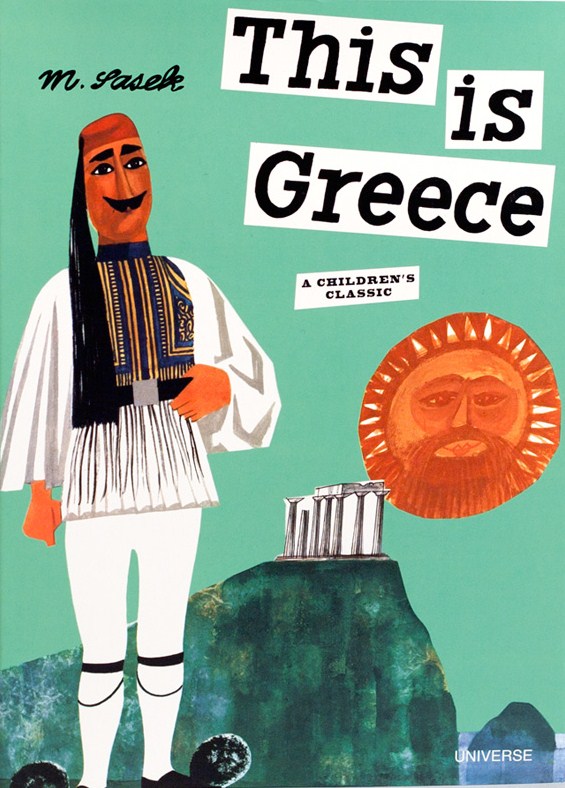


(all photographs reproduced here are via this SITE)


What is more interesting though is another Sasek book, published in 1961, called "Stone is not Cold" in which he used collages to incorporate photographs of ancient sculpture in his own humorous sketch settings. These sketches illustrate Greek and Roman sculpture photographs from the museums of London and Rome, which were obviously taken when Sasek travelled there to work on his "This is London" and "This is Rome" books. 

Given the fact that people often tend to refer to ancient Greek works of art as "sacred", Sasek's ingenious appropriations would easily be called "sacrilegious". 


******

Want to know more about Miroslav Sasek and his books? Click HERE


Πέμπτη 5 Ιανουαρίου 2012

Do I really need to comment?

Happy New Year everyone!


This is the first post for 2012. 
No basic theme really, just a cartoon strip on the incurably vivid imagination of archaeologists - or really what we often ask visitors to archaeological sites to do. 


Τρίτη 27 Δεκεμβρίου 2011

Ancient Greek Christmas

You would think the title of this post combines two incompatible elements "ancient Greek" and "Christmas", but modern day kitsch never fails to amaze us. 


Want your Christmas tree with a touch of ancient Greek splendour? 
Why not choose this elegant Parthenon glass ornament for only 22,99 $?


(really want it? think again or click HERE)


or, better still, why not combine the Parthenon with a touch of the traveller's experience with this magnificent suitcase-shaped glass ornament for only 19,99 $


(want this one too? sure? then click HERE)


You could of course choose a relief version of the Parthenon...


(must have it? click HERE)


or settle for a pars pro toto with this piece of an Ionic column all christmasy-looking with its red bow


(can't live without it? click HERE)


Not christmasy enough? Perhaps have it in gold? 


(yours to order, if you click HERE)


******
I know it's now too late to wish everyone a merry Christmas, but I'm just in time to wish you a Happy New Year!


Πέμπτη 8 Δεκεμβρίου 2011

Society Goddesses

Yevonde Cumbers Middleton (1893-1975), or Madame Yevonde, as she was better known, was an English photographer who pioneered the use of colour in portrait photography. Well-educated and an avid supporter of the women's rights movement, this independent lady set up her own photographic studio in London in 1914 being just 21 years old. She experimented with colour photography and the new Vivex technique and became well-known for her portraits of leading personalities of the day.  

During the 1930's Madame Yevonde shot a series of photographs, named "Goddesses" portraying well-known socialites of the day dressed up as mythological figures. 

According to Wikipedia 
"Yevonde's most famous work was inspired by a theme party held on March 5, 1935, where guests dressed as Roman and Greek gods and goddesses. Yevonde subsequently took studio portraits of many of the participants (and others), in appropriate costume and surrounded by appropriate objects. This series of prints showed Yevonde at her most creative, using colour, costume and props to build an otherworldly air around her subjects. She went on to produce further series based on the signs of the zodiac and the months of the year. Partly influenced by surrealist artists, particularly Man Ray, Yevonde used surprising juxtapositions of objects which displayed her sense of humour."


April Aileen Freda (Leatherman) as Minerva/Athena


Mrs Donald Ross as Europa


Mrs Richard Hart-Davis as Andromeda


Lady Dorothy Etta Warrender (née Rawson, later Lady Bruntisfield) as Ceres/Demeter


Lady Alexandra Henrietta Louisa Haig as Circe


Lady Bridgett Elizabeth Felicia Henrietta Augusta Poulett as Arethusa


The Honorary Mrs James beck as Daphne


Mrs Edward Mayer as Medusa


The Honorable Mrs Bryan Guinness as Venus/Aphrodite


Lady Milbanke as Penthesileia


Mrs Anthony Eden as Clio


Dorothy, Duchess of Wellington as Hecate


Madame Yevonde, Self-portrait, National Portrait Gallery, London
(note the Hecate portrait over the frame) 
[via]


******

The "Goddesses" photographs have been published in book form (see here) and recently exhibited at the PM Gallery and House in London - see an article in The Guardian here

A major exhibition on Madame Yevonde's work took place in the National Portrait Gallery, London in 1990 and a catalogue was published by R. Gibson & P. Roberts, Madame Yevonde: Colour, Fantasy & Myth, London 1990.

Photographs reposted via here & here.  

If you want to know more on Madane Yevonde see here and here

Last but not least, you may browse 290 photographs of Madame Yevonde in the National Portrait Gallery site - just click here


******

P.S. Though as a rule the blog claims no copyright on any of its content, people reposting huge chunks of its posts, photographs, ideas, etc. without mentioning it as a source, should keep in mind that there is such a thing as "netiquette" or common courtesy which requires due attribution. 
Much like we (try to) do in Classics with referencing and quoting ;)

By the way, Madame Yevonde's most famous quote is "Be Original or  Die!"

Τρίτη 6 Δεκεμβρίου 2011

Hair

In 2009 students from the Fairfield University College in Connecticut, under the supervision of their teacher Dr Katherine Schwab, worked on a very interesting project: 
the Caryatid Hairstyling Project.


[Students posing as Caryatids: Sandra Cimino, Dana Westrup, Amber Nowak, mara Giarratana Young, Caitlin Parker, Shannon Berger]


The six Caryatids in the south porch of the Erechtheion on the Acropolis wear long hair arranged in a variety of braids and patterns. The project aimed at testing whether these hairstyles were representing artistic convention or were in fact inspired by real hairstyles of the day. 


Dr Schwab working together with professional hairstylist Mixely Torres attempted to replicate these hairstyles working on six students with long thick hair in varying textures.
The result? 

"Not only was it possible to replicate the hairstyles of the renowned Caryatids, but the process itself yielded insights into hairstyling techniques both ancient and modern, as well as a way to enter the realm of antiquity. The Athenian Caryatid hairstyles provide a window into an ancient time and place when young women became part of their society through the manner in which their hair was worn. Equally, today these complex hairstyles form a connection between contemporary and ancient society while demonstrating how braids continue to fascinate and inspire contemporary trends in hair fashion."


The Caryatid Hairstyling Project was recorded and presented into a short DVD film, but one may watch the following instructive clip released on YouTube.


******
Need more info? 


Start by visiting the Caryatid Hairstyling Project page here and read interesting interviews by Dr Schwab here and here.


******


I've had the idea of presenting this project in the blog for a long time now, but strictly speaking this fell under the category of "experimental archaeology" rather than consuming Greek antiquity in a modern way. 


Well, thankfully, Berkeley student Celeste Jacobson-Ingram came to my rescue, after suggesting several examples of contemporary hairstyles that are evidently influenced by ancient Greek and Roman examples. 


[via]


[composite photograph courtesy of C. Jacobson-Ingram]


Παρασκευή 25 Νοεμβρίου 2011

Kylie Aphrodite

Kylie Minogue's choice to portray Aphrodite certainly deserves a post on this blog, especially since it was presented not just in a CD, but in a world tour with stage sets and appropriate Dolce & Gabbana costumes, thus offering a more "complete" visual experience.

In all honesty, I think that there's so much material to examine and work with, that it would make a nice idea for an article of a well-documented case of consuming Greek mythology & iconography.

The CD includes two songs, readily identifiable as having being inspired by the central mythological theme, i.e. "Cupid Boy" and "Aphrodite"

I'm fierce and I'm feeling mighty,
I'm a golden girl, I'm an Aphrodite


Interestingly enough the world tour actually combined two theme/concepts, "Aphrodite" and "Zigfield Folies" (!!) thus named eventually "Aphrodite Les Folies".


Here follows a series of photographs I collected from the web showing Kylie - Aphrodite with winged headpiece emerging from a large sea-shell, perfoming in front of a mock-Greek style facade, nursed by female attendants, riding Pegasus and mounting a chariot with her male warriors.


Related videos are of course plentiful, thus really hard to choose from. 
I'm posting only two here, the first including characteristic scenes of all the programme, the second the opening act and "Birth of Aphrodite" underwater scene.


For those interested to learn more and continue exploring, you may want to start from the singer's official site HERE, then follow THIS Wikipedia link on the album and THIS link on the tour.


Τρίτη 22 Νοεμβρίου 2011

Lego in search of Atlantis - 100th post


In 2010 the well-known Lego toy company released Lego Atlantis, a product range themed around the underwater world of the long lost ancient city of Atlantis.


The product range includes 19 sets and a crew of basic characters. The "good" characters are the deep sea salvage crew who search the ocean for shipwrecks and treasure, including Captain Ace Speedman, Marine biologist Dr Jeff Fisher, First Mate Lance Spears, 'Tech Expert' Axel Storm, apprentice Bobby Buoy and Professor Sam Rhodes. 
The "evil" characters are described as 'Atlantis Warriors', have human-like bodies with the heads of a sea creature, and are accordingly named: i.e. 'Squid Warrior', 'Manta Warrior', 'Shark Warrior'.

The company has released 19 sets of toy products so far, as well as a movie and an online game named "The Quest for the Golden King" -you can play it clicking HERE.


In the following first part of the Lego Atlantis movie (3.22 ff), Prof. Sam Rhodes explains the story of the city using a projector (!) and black & white slides -not-so-high-tech right?

"Legend tells of an island in the Atlantic that contained a great city with riches beyond our imagination. Its walls were made of precious metals, its architecture so advanced some believe we still have not matched it today, but volcanic activity on the ocean floor led to a tidal wave. The entire island was swallowed up by the sea, never to be seen again"


May thanks to Dr Kalliopi Sarri for alerting me to this exciting product.


By the way, this is the blog's 100th post~ Many thanks are due to all the readers, especially to those overseas, who have kept this project going and expressed their intense interest.