Δευτέρα 18 Απριλίου 2011

The philosophers' game

What if Ancient Greek and German philosophers solved their differences over a game of soccer?

Monty Python (of course!) have the answer.


I sincerely thank our blog reader "Ein Steppenwolf" for suggesting this.

Κυριακή 3 Απριλίου 2011

Invoking the Keratea kouros

A brief summary of the story so far for our foreign readers. 

The Greek Government decided to create a space for landfill in the region of Keratea, in Southwestern Attica, close to the site of Ovriocastro. Ovriokastro is a fortified hill site with important archaeological remains and a life span ranging from the prehistoric to hellenistic times. Strangely enough, the area is a declared and protected archaeological site with Decisions by the Greek Ministry of Culture dating in 1980 and 1995.
Ever since the announcement of the government's intentions, the people in the region protest strongly and continously against the construction of the landfill, invoking in their arguments the great archaeological importance of the site.

[There are lots of full reports on the incidents related to this struggle, some of them in English and other languages as well, so if you're interested take a look here]


One of the most characteristic finds of the region is the so-called "Kouros of Keratea", currently in exhibit in the National Museum of Athens.


It is interesting to note that, although other important finds also come from the same region, even other statues of Kouroi and a Kore, this particular statue has become a symbol of the the struggle of the people in Keratea, often portrayed in their remonstration posters.


On March 22, 2011, another form of protest against the construction of the landfill took place in front of the National Archaeological Museum in Athens, current home of the Keratea Kouros. Students of the School of Fine Arts created a copy of the Keratea Kouros out of garbage and displayed it outside the entrance of the Museum.
According to the press reports the students said that "their aim was not to create an exact copy of the Kouros but rather to make a statue that would refer to the Kouros as he appears in their eyes after the construction of the landfill".

[press report here (in Greek)]


 ******

Note also that protest against the Keratea landfill also took place in the Poseidon temple in Sounion.


Τρίτη 29 Μαρτίου 2011

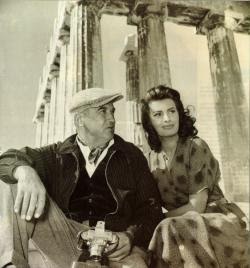
You say he's only a statue


Sophia Loren posing with co-star Alan Ladd in front of the Erechteum in the 1957 film "Boy on a Dophin".


The film's plot revolves around the attempts by two competing individuals - an archaeologist and a wealthy art collector - to retrieve an ancient Greek statue of a boy riding a dolphin from the bottom of the Aegean Sea. Alan Ladd portrays the honest academic archaeologist, Dr. James Calder, whose aim is to see to it that the statue is handed over to the rightful Greek authorities. Clifton Webb on the other hand, plays a rich and unscrupulous grave-robber, Victor Parmalee, who wants to find the statue and keep it in his own private collection. Sophia Loren plays a Greek sponge diver, Phaedra, who accidentally found the statue and is trying to make money by assisting Webb's character, but gets romantically involved with Ladd's character.



The film score cover (more on the film music HERE)

The statue of the Boy on a Dolphin in the film supposedly granted wishes and the english lyrics of song of the film refer to this special quality (the Greek version of the song is a completely different story).


There's a tale that they tell of a dolphin
And a boy made of gold.
With the shells and the pearls in the deep,
He has lain many years fast asleep;
What they tell of the Boy on A Dolphin,
Who can say if it's true.
Should he rise from the depths of the ocean,
Any wish that you wish will come true.

You say he's only a statue,
And what can a statue achieve.
And yet while I'm gazing at you,
My heart tells my head to believe.
If the boy whom the Gods have enchanted,
Should arise from the sea,
And the wish of my heart could be granted,
I would wish that you loved only me.


The film was shot at Cinecittà, Rome, and on the Greek island of Hydra, but a scene was also shot on the Acropolis, probably to establish a suitable internationally recognisable archaeological background.


Sophia Loren and director Jean Negulesco on the Acropolis, during the film

[More on the film HERE]


Two screen shots of the statue starring in the film.

In my humble opinion, it's not the same statue in both cases. Among other differences, note that on the underwater shot the boy recalls the Artemision jockey posture, and on the ship the dolphin seems to have a much more arched back.

On the Acropolis scene, Phaedra (S. Loren) and archaeologist Jim Calder (A. Ladd) ponder on a sketch of the bronze complex - quite different from the actual find, showing two dolphins.

(film plot source: wikipedia)

Παρασκευή 25 Μαρτίου 2011

Taylor and Todd visiting Acropolis


February 8, 1958.

Elisabeth Taylor with then husband Michael (Mike) Todd visiting the Acropolis.

Taylor had married Todd a year ago, in February 2, 1957.
Only a month after these photographs were taken, Todd died tragically in a plane crash.

Δευτέρα 21 Μαρτίου 2011

Heads up!


Stelios Koudounaris is a Cypriot fashion designer who uses an ancient motif as his main logo.


The motif is portrayed on a silver cup with a wish-bone handle, with inlaid decoration. The cup, was found in a tomb in Enkomi, Cyprus, and was probably imported from Mycenaean Greece, dating from the 14th c. B.C. It is currently in exhibit in the Cyprus Museum at Nicosia.


Koudounaris' webpage [HERE] includes a short bio as well as an extremelly interesting comment on why the designer whose this particular image as an emblem of his creative work.

 
Stelios Koudounaris was born in Cyprus in 1981 and raised in a family fashion business. After studying Fashion Design and Garment Manufacture he moved to Athens and worked for some leading Greek fashion business as a fashion designer and stylist.
He is now presenting his 8th running personal collection for autumn/winter 2011-12 under his own label, called after him ''STELIOSKOUDOUNARIS''.


Since his very first collection, Stelios Koudounaris plays a leading role in Greek fashion system. International magazines like Harpers Bazaar, Madame Figaro, InStyle and more have presented his work for several times, while Greek souperstars choose his creations for their appearances.

Cyprus mufflon is used as his main logo, which is a statement traditional figure given a modern twist in order to explore his designs' sharp shaped pattern cutting and dynamics and slightly declare the designers'origin.

His collections are mainly driven by some rock and wild elegance always worked in such a way to elect a womans' body. His minimal approach to female sexiness evolves through a mixture of razor-cut clear designs and futuristic mood.

His making is mainly adapting couture like techniques to his pret-a-porter creations that are aesthetically perseverance in now-a-days.

"STELIOSKOUDOUNARIS" collections are exclusively manufactured in Greece and distributed in 40 selected selling points alongside Austria, Denmark, Poland, Greece and Cyprus.


It is of note though, that what Koudounaris interprets as a "Cyprus mufflon", is a well-known motif in Aegean art unanimously accepted in literature as a bull's head...